Gisela Baurmann Catherine Jones Signe Nielsen Galia Solomonoff Jason Anderson Lawrence Blough Karl Chu Jeffrey Hogrefe Jason Lee Peter Macapia Jason Vigneri-Beane
Brief:
Fitness is a fundamental concept in evolutionary theory and a defining theme for this studio. The investigation begins with the most common definition of the term fitness, which refers to a physical condition. By mapping physical exercise routines, data is derived that generates possible landscapes.
The second phase of the project consists of an intense evolutionary search within those landscapes for the most fertile building ground. Here, the possible grounds and their structural seedlings engage in a tight interaction, and consequently cannot be treated separately. Through probing and optimizing exercises, this phase nurtures select seedlings while developing combinatory logics, or ground rules, and establishing a site as an emerging structural matrix.
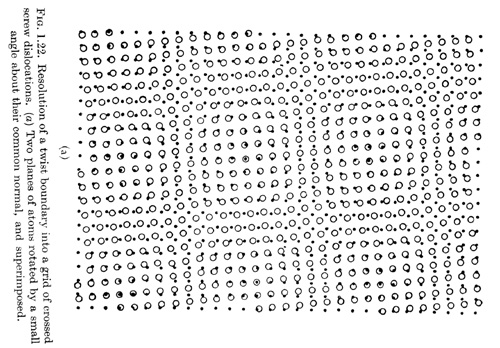
When a possible site has been established, it is analyzed to reveal both rhizomatic and hierarchical qualities. Here, as in crystallography, cellular formations and infrastructural networks are tested for their integrity and stability as well as for their deviations, dislocations and enclosures. Potential points of intervention are identified and internal growth is manipulated and exaggerated through external reference.
Finally, aberrations emerge from the meshwork and become objects of architectural speculation further guided by the programmatic demands of a gym.
Requirements:
Final model Fitness Studio Final model Detail Plan Fitness Studio Sections Fitness Studio
The final Fitness Studio model is the most comprehensive piece of your design work. It is a proposal that answers to core architectural demands, such as structure, shelter, program and circulation.
It will be read in context with and against your midterm field model (basswood limit 6x18x24) and show how much the default tectonic field - the site - has emerged and grown into an occupied building structure. Though based on the same tectonic language, the final model will differ significantly from its predecessor. While the midterm model established a language, the final model uses that language to compose a building.
While the midterm model was general, open and low-res., your final model is SPECIFIC, ENCLOSING and HIGH-RES.:
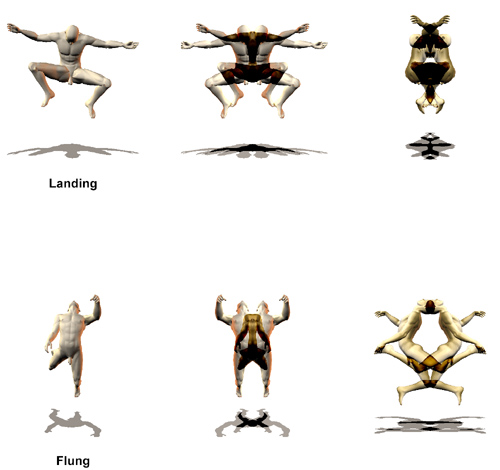
The final model is SPECIFIC in its response to the volumetric demands of your body in exercise. The body envelope (result of body analysis assignment 11) is understood as a measure of the human figure to support your sense of scale; it is also understood as a generator of specific spatial characteristic acting upon the structure, expanding the field and leaving traces of its spatial identity (It is not the sufficient volumetric expanse for a room as a restrictive program envelope).
The final model is also specific to the circulation derived from the project's exercise routine. The Fitness Studio is made up of a specific sequence of performance spaces generating a spatial continuum. The circulation space overlaps and loops providing for moments of contemplation and isolation as well as spaces of interaction and gathering. With the final model in hand you can give a 'walk through' of the Fitness Studio.
The final model is ENCLOSING as it provides the primal architectural function of shelter. The degree of openess and juxtaposition of open and enclosed space is specific to the programmatic needs of each exercise routine. However, each Fitness Studio provides some amount of enclosed space that allows for protection from environmental forces. Building entries and openings are articulated with great care to define these moments of transition. Outdoor spaces providing room for parts of the exercise routine are defined as performance ground and distinguished form the default site by the level of built-in resolution. At very few moments the final model resembles the midterm model; it is the uninhabited parts that communicate the transition to the general field.
The final model is a HIGH-RESOLUTION model that incorporates a specific tectonic syntax on dramatically different scales. The finer the grain the more responsive the building fabric to the programmatic demands. It is a high-resolution structure that incorporates distinctly different hierarchical levels that perform together as one coherent structure.
The structure of the final model is of much higher definition than the midterm field model. The final model not only passes the physical 'shake test' of structural stability; but it reveals a clear understanding of the system's hierarchical qualities. Primary load bearing elements are distinguishable from secondary elements and enclosure, screening modules.
Functional differences among building parts are incorporated. Walkable surfaces are treated differently than ceiling surfaces. Haptic, visual and lighting conditions are discussed on the model's smallest scale.
Final model Detail:
Scale 1/2" = 1'0" Basswood from sheets 1/16",1/4", 1/2"
The detail model provides an opportunity to discuss in depth the structural, material and phenomenological qualities of you architectural proposal. Issues like Scaled tectonics, Hierarchies, Joinery, Visual and Haptic properties can be developed at an adequate scale. The raw material (Basswood from sheets 1/16, 1/4, 1/2) is the same as for the 1/4 scale model to encourage a high level of fine articulation and craft. Sectional build up of wood profiles may be necessary. The selection of the detailed area is crucial; it shall incorporate a standard moment reoccurring throughout the Fitness Studio and it shall cover all main building elements.
Plan Fitness Studio:
Scale 1/4" = 1'0" Pencil on vellum 18" x 24"
A plan view drawing or horizontal section (plan) gives an overview of the Site-Structure relation, Circulation and Program distribution. It differs significantly from the default site plan (midterm) as it incorporates the architectural proposal.
Sections Fitness Studio:
Scale 1/4" = 1'0" Pencil on vellum 18" x 24"
A selection of generative site sections, horizontal and longitudinal, gives an account of the spatial sequences within the inhabited structural matrix at human scale.
South Street Seaport at the Exhibition Centre. Corner of Fulton and Front Streets. Take the G to Hoyt and transfer to the A uptown. Get off at Broadway-Nassau.
For a moment we take our focus off the ground and return to the training routine established in Week One. We identify body positions and derive the spatial demands for each exercise of the routine. While articulating the spatial characteristics of the exercises we introduce scale as an architectural means, starting with 1/4" = 1'-0". Ultimately we form an understanding of scale in relation to the human figure.
The Movements - of crowds, dancers, fighters - recall the inevitable intrusion of bodies into architectural spaces, the intrusion of one order into another. The need to record accurately such confrontations, without falling into functionalist formulas suggested precise forms of movement notation. An extension of the drawn conventions or choreography, this notation attempts to eliminate the preconceived meaning given to particular actions in order to concentrate on their spatial effects: the movement of bodies in space. Rather than merely indicating directional arrows on a neutral surface, the logic of movement notation ultimately suggests real corridors of space, as if the dancer has been carving space out of a pliable substance': or the reverse, shaping continuous volumes, as if a whole movement has been literally solidified, 'frozen' into a permanent and massive vector. (Bernard Tschumi)
We also want to show some appreciation for the phenomenological conditions specific to each exercise. Performing each activity, how does the body experience space? Is your routine designed to build endurance, strength or speed; how does that affect the experience? Privileged Wordset: Develop a matrix of terms that relates the Exercise (noun) of your routine and its Activity (verb) to a Spatial quality (adj.) Example:
warm-up / to crouch / compressed warm-up / to stretch / expansive warm-up / to jump rope / continuous
sparring / to jab / measured sparring / to swerve / dented sparring / to duck / depressed
The authenticity of Architectural experience is grounded in the tectonic language of building and the comprehensibility of the act of construction to the senses. We behold, touch, listen, and measure the world with our entire bodily existence and the experiential world is organized and articulated around the center of the body. Our domicile is the refuge of our body, memory and identity. We are in constant dialogue and interaction with the environment, to the degree that it is impossible to detach the image of the self from its spatial and situational existence. "I am the space, where I am," as the poet Noel Arnaud established. (Juhani Pallasmaa)
In addition to the individual moments of perception we map the procedural character of the routine. From the bodily procession emerges an infrastructural, navigational system, which currently comes in the form of an abstract notation - a circulation diagram. It defines the sequence of spaces and spatial potential of an overlapping and loosely knotted path.
On Monday 03/27 pin-up in HHS 517 :
- Body analysis, sequence of sections, generative notations and axons 18 x 24 - Privileged Wordset, as part of improved script and stand alone list - Circulation diagram, axonometric drawing, pencil on vellum 18 x 24
Also pin up your reworked Site Model, the second generation Photo Documentation, and the Axonometric Site Analysis you have prepared for today.
A fertile ground has been found and undergoes a deep site analysis revealing both rhizomatic and hierarchical qualities. Cellular formations and infrastructural networks are tested for their integrity and stability as well as for their deviations, dislocations and for their enclosures. Potential points of intervention are identified; internal growth is exaggerated and manipulated externally. Monstrosities emerge from the meshwork and become objects of architectural speculation. Programmatic demands start to guide the speculation ..
Assignment Ten
Document and thoroughly analyze the site. In your analysis consider both intensive and extensive properties of the ground, testing points as well as assemblies.
- Photo Documentation: Capture your basswood site from bottom and top. Move the light sources and define 3 corresponding positions for both sides, casting distinctly different shadows across the field. Examine how specific tectonic and spatial properties are amplified by the projected shadows, how patterns solidify and open up. Print out a series of 6 high contrast images (b/w) in 1/2 model scale, 9x12.
- Axonometric Analysis: Generate a 30/60 axon based on the recent plan and sections of your site. Draw visible and hidden lines; establish hierarchies of material thickness; inscribe infrastructural systems and cellular formations. Use line weight –type to distinguish layers of information within the drawing, as well as hierarchies within the construction lines, pencil on vellum 18 x 24
Gisela Baurmann Rhett Russo Jeffrey Hogrefe Courtenay Bauer Hinki Kwong Sarah Ghandour Stephen Siew
Requirements:
Site model in basswood, limit 6x18x24, basswood sheets 1/16, 1/4, 1/2 Generative site sections horizontal (plan), pencil on vellum 18 x 24 Generative site sections longitudinal (2) latitudinal (2), pencil on 2 vellum 18 x 24 Creatures fitness sequences, 3x3x4 (new generations in basswood) Script, 8.5x11 (8 copies and update on blog)
Optional:
Site Axonometric, pencil on vellum 18 x 24
Bring all other project material, pin up Best of Project One and Two
Sat 3/04 : Additional meeting at 6pm Mon 3/06 : Midterm Review at 2pm / Handout assignment Ten (start project Three) Thu 3/09 : Studio gathers for Kahn symposium at 2pm. no class Mon 3/13 : Assignment Ten due, Pin-Up at 2pm Thu 3/16 : Handout assignment Eleven, brief meeting, time tba Spring Break Mon 3/27 : Assignment Elevem due, Pin-Up
The greatest feeling you can get in a gym, or the most satisfying feeling you can get in the gym is... The Pump. Let's say you train your biceps. Blood is rushing into your muscles and that's what we call The Pump. You muscles get a really tight feeling, like your skin is going to explode any minute, and it's really tight - it's like somebody blowing air into it, into your muscle. It just blows up, and it feels really different. It feels fantastic. (Schwarzenegger)
The main deliverable for the mid-term is a final basswood model for the performance landscape; limit 18x24x6, built up from three basswood sheets: 1/16, 1/4, 1/2. At this point, main areas of research and the conceptual framework have been established; Testing Grounds have emerged, and the evolution of Creatures (structural seedlings) is well under way. We introduce a 3D authoring tool in order to support the synthesis of creatures and ground (lattice and cell). The continuity of the individual projects needs to be assured, and all work is geared towards the mid-term deliverable, the basswood model.
It will be rewarding to address the cell/lattice operations, and it is a major act of transposition to feed the results back into the basswood realm. We shall take a very pragmatic approach to this. Simple screenshot print outs serve as templates for basswood elements to be built up. We do not use the tool as a representational one, but use it for its generative powers alone. Renderings are excluded and we go as far as eliminating any prints from presentations; successful line drawings need to be reworked in pencil on vellum to become part of the presentation material. The 3D tool registers in a project only through the immediate impact on the physical model.
We will introduce the very basics of the software and limit the package to a tight set of essential tools. The geometry will be limited to nurbs, understanding of nurb surface tectonic is key. Hierarchies of CVs, curves and surfaces shall be understood. Issues of control and curve intelligence shall be discussed. CVs are counted and indexed. All operations are recorded numerically. References nurb-surface-tectonic to wood-tectonic are welcome. Transposition between pure surface geometry and basswood in different thickness is important.
After a brief round of familiarizing with the tools, present data of the project will be converted into xyz location of CVs. (snap grid (unit=inch) ¼ subdiv) Sets of simple curves with a given cv count generate simple, very clean nurb surfaces. Operational integrity with current stage project is privileged over formal identity, yet formal references are encouraged. Three creatures emerge in direct lineage from current paper and basswood models; they are enhanced in sequence within the tool and transported right back into the phys. model. Operations are based on project recipes and operational language (fitness and crystallography, see 'Works' above) Direct links are made between recent paper enfolding model and nurb manipulations.
Combinatory logic is tested in series (structural matrix formation) expanding the field. Emerging landscapes are to be seen in direct relation to existing ‘testing ground’ models (paper). Patterns and lattice formations are generated in continuous variation. Simple numerically controlled duplications in series generate first landscape formations.
Interface, navigation, basic settings, groups and hierarchies, outliner as organizational tool, cv curve tool, lofting and manipulators will be introduced in the first session today. Surface operations for creatures, duplication techniques for landscape formations and use of templates will be discussed in a second session tomorrow.
Two recipes, one written in the language of a personal trainer (workout), and one written in the language of a crystallographer (formula), describe your project in precise terms and serve as a set of instructions. (2 x 250 words, Arial 10 point on one 8 1/2 x 11)
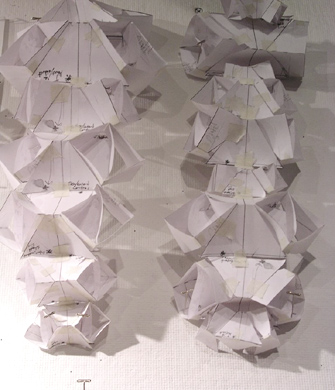
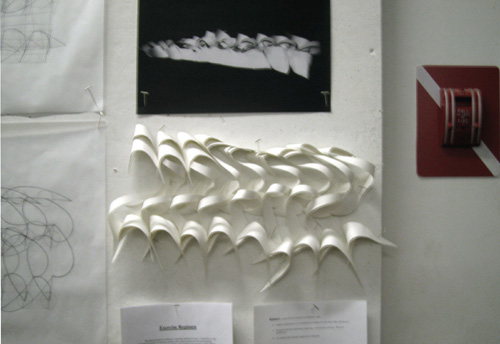
The instructions are accompanied by a model sequence (4-5 instances in white paper or museum board, mounted on foam core 10 x 24) showing discrete steps of manipulation for one creature, c1. (Additional set for c2, c3 are optional)
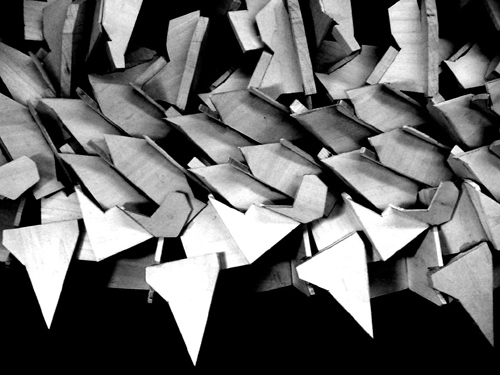
Be specific about the properties you created by manipulating the material. Cutting in one direction allows a maneuver in the other etc. When cuts are not needed at a certain point, leave them out next time, or explore the spatial potential of those extra cuts. When material is unfolded and becomes flat your manipulations show, revealing a material logic. Later you might discover that the sheet and the creature both are beautiful, as flat and sculpted pieces respectively.
Draw the creature as well as its prepared material, showing how one emerges from the other. Reintroduce material thickness; inscribe 1/16, 1/4, 1/2 into the next set of three generative sectional drawings (pencil on vellum 12 x 24).
Instead of e-mailing the pictures of the basswood models to Jonas, I created a webshots account, which we can continually update so Jonas can see our work. The account name is fitnessstudio (no spaces) and the password is Jonas. I made an album for everyone in the class. You simply log into the site, click the album with your name, and upload your photos.
Project Two launches an intense evolutionary search for the most fertile building ground. Possible grounds and their structural seedlings engage in a tight interaction and cannot be treated separately. In a process of probing and optimizing we simultaneously breed a species of structural seedlings (creatures) with their combinatory logic (ground rules) and an emerging structural matrix (site). We synthesize a bottom-up approach to cellular formation and a top-down heritage of architectural site formation/analysis.
Assignment Six
Cut one section through each of the 2x3 basswood creatures in model scale. Within each drawing overlay 'as is' section with 'possible' section. The overlay exaggerates distinct spatial and tectonic features of the individual unit. Use different line weight and -type to distinguish and identify overlaps, and accentuate qualities - a generative drawing emerges. Lay out 6 sections on one page, pencil on vellum (18x24). Build a prototype for the second generation creatures (each: white paper (thin), museum board (mid) and white foam core (thick)) - limit 3x3x4, enhancing qualities as identified in the generative sections (above). Build the second generation in basswood.
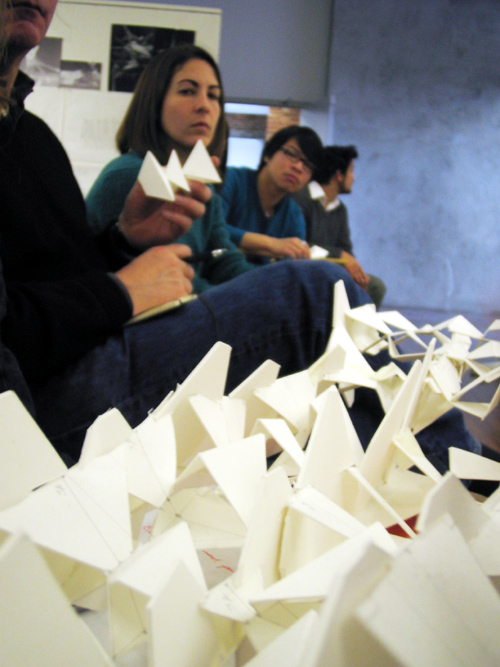
In parallel, build simple white paper version of the creatures to test their combinatory logic and their potential for a second generation testing ground. Build the second generation ground as a prototype (paper, museum board, foam board) - limit 6x12x24.
Assignment Six is due on Monday 2/13. We will meet right after the year wide screening of "Koyaanisqatsi" and have a full studio session during which you will present the second generation creatures and the second generation ground (prototype).
I will be in studio briefly on Thursday 2/9 to view the process of assignment 6 and discuss a possible field trip this weekend. After that I will be on Cathy Jones' review (HHS 3rd flr hall). Everybody is encouraged to visit that review for a few presentations before continuing work in studio
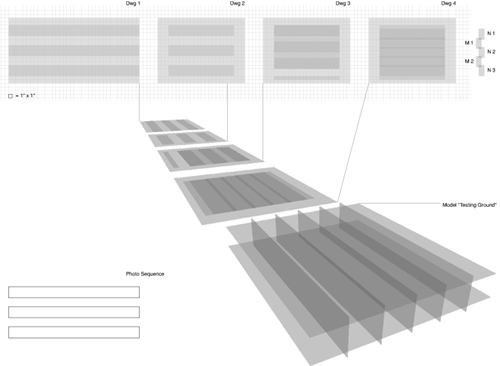
Identify three characteristic moments within the testing ground. Each moment frequently reoccurs within the field in continuous variation. It resurfaces - topologically identical and changing in proportion - at least three times. It holds distinct spatial properties and performs as a piece of joinery throughout the ground. Moments may be related to N1-N3 or M1, M2; but they are not exact replicas of frames within any of these notational sequences.
For each moment draw three two sections through the entire testing ground in full model scale. A cross-, longitudal- and diagonal section cut the moment. Choose cutting planes that reveal most information. Within each section highlight the part that cuts trough the selected moment. Use different line weight to distinguish. All sections are generative drawings, none is representational of the testing ground model. Draw a plan view of the ground and mark as continuous lines all cutting planes of the nine six sections. (Pencil on vellum)
Build the three moments as study models in paper, chip-, museum-, or finboard.
I am very happy to announce that our studio will engage in a close collaboration with Jeffrey Hogrefe's English 103 class (taught in two sections at 9:00 and 12:00 on Mon and Wed in 212 HHS). Jeffrey has offered to assist all of you, even those who are not enrolled in his class. This is an exceptional opportunity for our studio and I encourage you to make full use of it.
In-class free-hand exercise "continuous variation". Have pencil and paper (8 1/2 x 11) ready.
Although diagrams can serve an explanatory function, clarifying form, structure or program to the designer and to others, and notations map program in time and space, the primary utility of the diagram is as an abstract means of thinking about organization. (Stan Allen)
Meeting Two
In two short readings for Thursday (Allen and Tufte) we find two fundamental concepts, one for notations, and one for diagrams. Note how the empirical method with accurate and direct recording allows Galileo to question preconceived notions. Note Kittler’s concept of "transposition" and how it is fundamental to the diagrammatic practice.
Rework and redraw your movement notations on the basis of today's feedback. Be very literal in your temporal and spatial recordings; leave out no detail of the source material. Consider the notations as scientific assessments of select moments within your training routine.
In a second drawing the notations are compressed to l = 18". Identify critical operations within the three notations; mark and connect specific points: trigger points, turning points, high points, nodal-, attractor-, control points, and levers. The notations can be read outside of their original context of the body's exercise. Abstract organizations emerge. (pencil on vellum 18" x 24" horizontally)
Identify moments of qualitative change, and put into words their properties and behaviors; articulate their spatial effects. Generate a list of operative terms (8 1/2 x 11 portrait, Arial 12 point), so that you can describe the observed with great and greater specificity. The terms are taken from the world of fitness, yet describe universal spatial operations (ex. crossing, stretching, racking).
In a third drawing the three organizations of the second drawing connect and form a field. Identify similar and identical moments within the three organizations and draw out their connections. 12" x 18" area in pencil on vellum 18" x 24" horizontally. Continue to use different line weight (3: thick, medium, thin) and -type (2: continuous, dashed) to account for different layers of information.
Assignment Two is due on Thursday 1/26. Three drawings, a list of terms and the readings will be discussed in class.
Ongoing research:
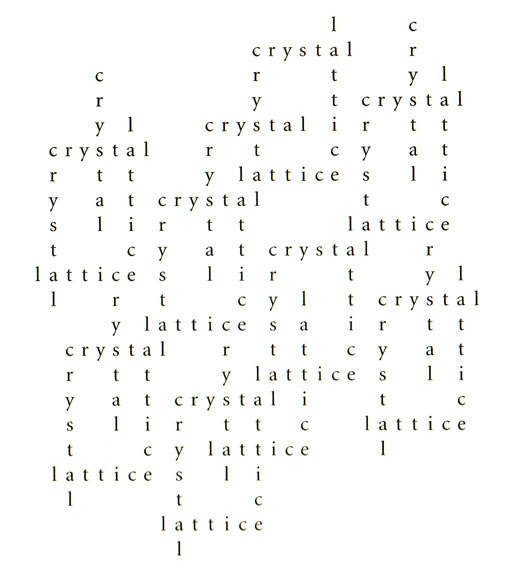
Crystallography is the experimental science of determining the arrangement of atoms in solids. Start light reading into one of the following areas: Miller index (notation), Symmetry operations, Lattice structures, Defects (Dislocation et al.), Physical Properties (Materials science)
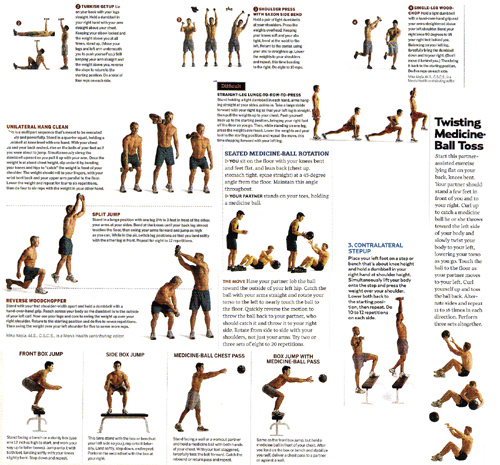
Fitness is a central concept in evolutionary theory, and in optimization techniques it is an objective measure of how good a found solution is. While deeply exploring Fitness in those terms and extensively utilizing the respective techniques, we start with the common use of the term that refers to being in good shape and physical condition.
Assignment One
Assemble a training routine to improve your physical fitness. The routine addresses your general condition, and zeros in on one specific area (flexibility, endurance, strength, shape). Organize in sequences, then type up the program of your routine (one page 8 1/2 x 11 portrait, Arial 12 point). List the name of each exercise with relevant additional information (duration, frequency, equipment, orientation, soundtrack).
Team up with a class mate (sparring mate) whose routine is compatible (similar focus, environment). Exercise your entire routine once and collect performance data (heart rate, body fat, # iterations, time). Save the data as it allows you to measure your progress.
Select three sequences from your routine to be video recorded. From each recording extract 6 - 18 consecutive/same interval frames. Deliberately choose a sequence that reveals both continuation and variation. Mount your still images as three horizontal strips (l = 36" ) onto one piece of paper.
Draw three movement notations on the basis of your photo sequences. Start with a 36" vellum overlay inscribing your body and its axis as they occur in each frame. Draw simple outlines capturing the general expanse of the body; draw straight lines as axis. Connect and interpolate the frames. Consider different line weight and -type to account for different layers of information. Develop a language of notation that is consistent throughout all frames and sequences.
Read Marey, Tschumi and a fitness magazine of your choice.
Assignment One is due on Monday 1/23. Pin up and present your frame sequences and time based notations, and be prepared to talk about your readings.